Karnataka drinks 9.1 litres per person — well above India’s average. Here’s what Bangalore’s alcohol problem really looks like, and how treatment actually works.


Karnataka sold 6.8 crore cases of liquor last financial year. That is roughly 17% of everything sold in India, from a state with about 5% of the population.
The state now drinks 9.1 litres per person a year, against a national average of 6.4. The estimated social cost — healthcare, lost productivity, road accidents, family breakdown — runs to ₹51,000 crore annually. That is between 1.4% and 2.6% of Karnataka’s entire economic output, drunk away and paid for twice.
If you are reading this because of someone in your family, that context matters. Not because statistics help a person stop drinking. But because most families arrive at this point believing they are dealing with a personal failure. They are not. They are dealing with something that is happening to hundreds of thousands of households across this state, and that has a known, documented, clinical answer.
Here is what the situation in Bangalore actually looks like, and what treatment in the right alcohol de-addiction centre does that willpower cannot.
The problem is not who you think it is
There is a picture most people carry of an alcoholic. It is usually someone visibly unwell, unemployed, unable to function.
That is not who we treat from Bangalore.
The people who come to us from this city are, overwhelmingly, employed. Often well employed. Karnataka data shows 16.5% of men aged 15 to 49 drink, and in Bengaluru the heaviest use sits with professionals in their late twenties to early forties — the same demographic that fills Whitefield, Electronic City, Koramangala and Indiranagar.
The pattern is almost always the same. Drinking begins as decompression after work. Then it becomes the only reliable way to switch off. Then it becomes something the day is organised around. Tolerance climbs quietly. Function stays intact for a surprisingly long time — which is precisely the problem, because functioning is what everyone points to as proof that there is no problem.
By the time a family calls us, the drinking has usually been dependent for years.
Bangalore’s specific pressure
Every city has its own version of this. Bangalore’s runs on three things.
Work that never closes. Long sprints, on-call cycles, and teams distributed across time zones mean the workday genuinely has no edge. Alcohol becomes the switch that ends it. Where the pressure is highest, we also see stimulants used to stay sharp and alcohol or sedatives to come down — a cycle that stops being optional very quickly.
Money without structure. Bangalore pays young people well and early. Disposable income plus no domestic accountability plus a dense pub culture is not a moral problem, but it removes most of the natural friction that would otherwise slow drinking down.
Total social normalisation. In Bangalore, not drinking requires explanation. Drinking does not. That asymmetry is why dependence is so rarely named — the behaviour is invisible against the background.
The part nobody mentions: Karnataka cannot treat the damage
This is the fact that should worry people more than the consumption figures.
In a legislative discussion in 2025, it emerged that Karnataka has one government institute treating liver cirrhosis, and roughly 30 gastroenterologists for the entire state. Alongside that, the government set a liquor sales target of ₹43,000 crore for 2025–26, while about 2.2% of deaths in the state are attributed to liver disease.
Read those numbers together. The state’s capacity to sell alcohol vastly outstrips its capacity to treat what alcohol does.
For a family, the practical implication is uncomfortable but useful: do not wait for the medical system to catch the problem. By the time alcohol-related liver disease is diagnosed and queued for specialist care, the window in which treatment is straightforward has usually closed. The cheapest, easiest, most successful point of intervention is always earlier than it feels.
Why stopping alone usually fails
Families almost always try the same sequence first. A promise. Then a resolution. Then a deadline. Then an ultimatum.
It rarely works, and not because the person lacks sincerity.
Sustained heavy drinking changes brain chemistry. The systems governing reward, stress response and impulse control adapt to the presence of alcohol and stop working properly without it. When drinking stops abruptly, the nervous system rebounds — anxiety, insomnia, tremor, agitation, and in serious cases seizures or delirium tremens, which can be fatal.
This is the single most important thing on this page: unsupervised alcohol withdrawal can kill people. Alcohol is one of very few substances where quitting cold turkey carries a genuine mortality risk. Anyone who has been drinking heavily and daily for years should not detox at home without medical assessment.
Beyond the physical, there is the environment. A study of relapse among people treated through camp-based de-addiction in the Bengaluru rural district found the usual clinical factors mattered — but so did unemployment, boredom, and peer pressure at social occasions. Recovery does not happen in a clinic. It happens in the life a person returns to.
What treatment actually consists of
Stripped of the marketing, credible alcohol treatment has four parts. Any programme that skips one is incomplete.
1. Medical assessment and supervised detox. Withdrawal is managed with medication, monitoring and clinical oversight. This is a medical procedure, not a test of resolve. It typically takes about a week, and its purpose is narrow: get the body through withdrawal safely so that actual treatment can begin. Detox alone is not treatment. On its own, it changes almost nothing.
2. Therapy that addresses why. Cognitive Behavioural Therapy is the most evidence-backed approach for alcohol dependence — it works on the specific thoughts, triggers and situations that lead to drinking, and builds different responses. Where there is underlying anxiety, depression or trauma, treating only the drinking guarantees relapse. This is what dual diagnosis means, and for a large share of the people we see it is the whole ballgame.
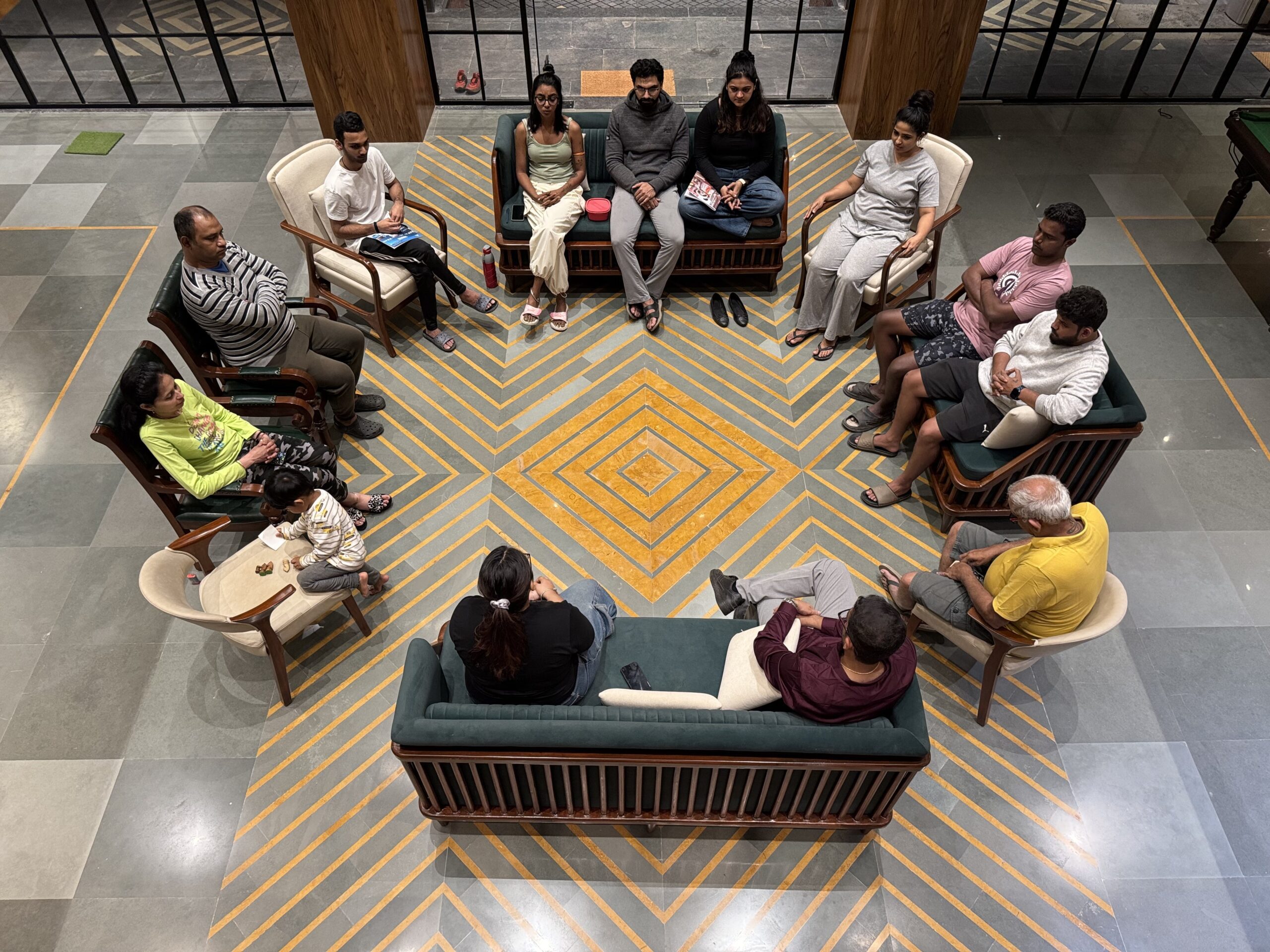
3. Family work. Addiction reshapes a household. Roles shift, resentments accumulate, and patterns form that unintentionally sustain the drinking. Returning a treated person to an untreated system is one of the most reliable ways to fail. Good programmes treat the family, not just the patient.
4. Aftercare. The first year is the vulnerable one. Structured follow-up, relapse-prevention planning and continued support are what convert stopping into staying stopped. If a centre cannot describe its aftercare in specific terms, that tells you something.
Should treatment happen in Bangalore?
An honest answer, from a centre that is not in Bangalore.
Outpatient treatment inside the city can work — where dependence is mild, insight is strong, home is stable, and the person can genuinely go to work each day without drinking. Some people fit that description.
Most who reach the point of searching for a de-addiction centre do not.
The argument for residential treatment away from the city is not that Bangalore lacks good clinicians. It is that Bangalore contains the entire architecture of the drinking: the colleagues, the Friday circle, the route home past the same shop, the pressure that started it. Early recovery is fragile. Asking someone to rebuild it while sitting inside every cue that dismantled it is a high-difficulty setting, chosen by default rather than design.
Distance does something no therapy can. It removes access.
There is a real trade-off, and it should be named: leaving the city means time away from work and family, and it costs more. For mild dependence caught early, that may not be warranted. For dependence that has already survived several sincere attempts to stop, it usually is.
How to judge a centre
Questions worth asking, in order of how much they reveal:
- Who supervises detox, and what are their qualifications? You are asking whether a doctor is managing a medical procedure.
- What is the staff-to-client ratio? This determines whether treatment is individual or processed.
- Which therapies, specifically? “Holistic care” is not an answer. CBT, REBT, family therapy, dual diagnosis are answers.
- Is it voluntary and open? Involuntary confinement produces compliance, not recovery. Ask directly.
- What does aftercare consist of, and for how long? Vagueness here predicts what happens after discharge.
- What happens if there is a relapse? A centre with an honest answer is a centre that has thought about real outcomes.
Any centre that promises a cure, guarantees success rates, or refuses to discuss relapse should be discounted immediately.
The thing worth holding on to
Alcohol dependence is one of the most treatable serious conditions in medicine. That gets lost in the shame around it.
It is not a character defect and it is not a life sentence. It is a chronic, well-understood condition with established treatment, and outcomes improve enormously with proper care — the difficulty is that the illness itself argues against getting that care, persuasively, in the patient’s own voice.
If you are reading this for someone you love: the fact that they have not stopped is not evidence that they cannot. It is usually evidence that they have been trying to do alone something that is not designed to be done alone.
Related Articles:
- Alcohol Addiction Treatment in India — how alcohol dependence is treated clinically
- Rehabilitation Centre for Bangalore — residential treatment for Bangalore families
- Signs Someone You Love Has an Addiction — what families notice first, and what they miss
- How Long Does Drug Rehabilitation Actually Take? — honest timelines
- Why Rehab Fails for Some People — the factors that predict relapse
- Dual Diagnosis & Mental Health — treating addiction alongside anxiety, depression and trauma
Sources
- Resource Mobilisation Committee, Government of Karnataka — excise reforms study drawing on NFHS data (2026): per-capita consumption, ₹51,000 crore social cost, IMFL sales figures.
- National Family Health Survey (NFHS-5), 2019–21 — alcohol prevalence among men and women in Karnataka.
- Karnataka Legislative Council proceedings (2025) — liver cirrhosis treatment capacity, gastroenterologist numbers, liquor revenue targets. Reported in Deccan Herald.
- Rampure R, Inbaraj LR, George CE, Norman G. Factors contributing to alcohol relapse in a rural population: Lessons from a camp-based de-addiction model from rural Karnataka. Indian Journal of Community Medicine, 2019.
Medically reviewed by Dr. Sayantani Mukherjee — MBBS, MD Psychiatry. This article is for general information and is not a substitute for professional medical advice. If you or someone you know is drinking heavily and daily, speak with a qualified clinician before attempting to stop.