The Jellinek curve hangs in rehab centres around the world, but it was built on 98 questionnaires and wasn’t even drawn by Jellinek. Here are his four phases and five types of alcoholism, what later research confirmed, and what it means for families today.

ZorbaCare Research · Evidence review · Medically reviewed by Dr. Sayantani Mukherjee, Psychiatrist · Published November 2026 · 19 references
Background. The Jellinek model is the best-known description of how alcohol addiction develops. Its four phases, and the U-shaped “Jellinek curve” that adds a path to recovery, still hang on the walls of rehab centres around the world, including in India.
Approach. We went back to E. M. Jellinek’s original 1946, 1952 and 1960 work, the archive research on how the curve was actually created, studies that tested his phases, and modern evidence from national surveys, diagnostic manuals and neuroscience.
Findings. Jellinek’s model rested on a small, hand-picked sample of Alcoholics Anonymous members, and later studies gave it only modest support. The famous curve was drawn by British psychiatrist Max Glatt, not Jellinek. Addiction is not a fixed one-way slide: many people recover, and they can stop at any stage. But Jellinek’s core ideas, that alcoholism is a medical condition and that loss of control is central, still shape treatment today.
Implications. The model is useful for recognising warning signs early, not for predicting anyone’s future. Families should act on the signs, not wait for the “chronic phase” or “rock bottom”.
Key findings
- The original sample was tiny. Jellinek’s 1946 study used 98 questionnaires that he hand-picked from 158 returned, out of 1,600 sent to members of Alcoholics Anonymous [4].
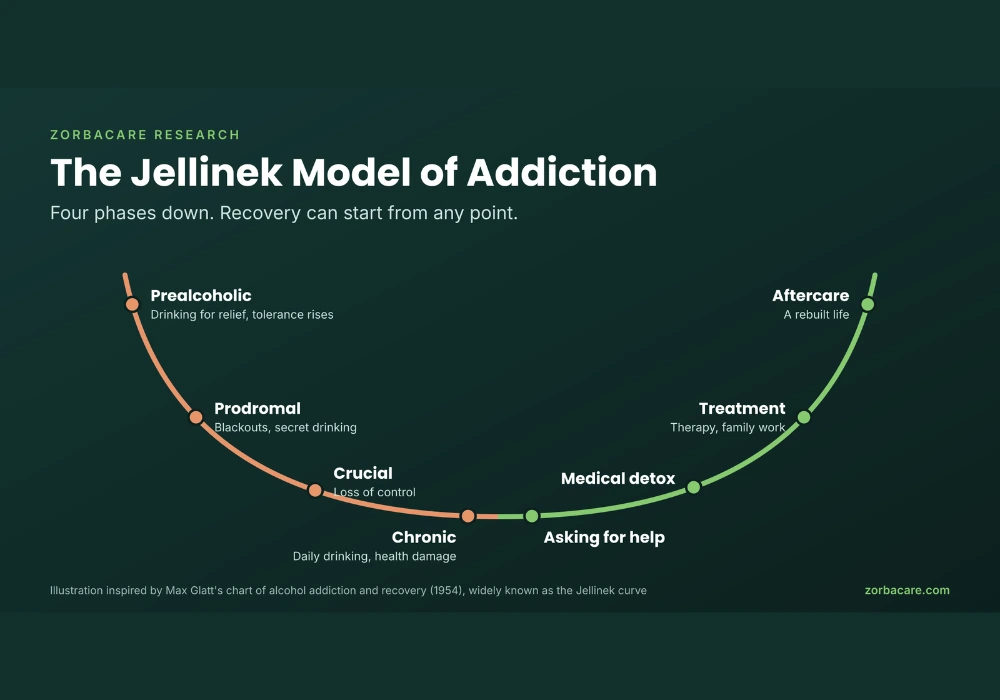
- Four phases. His 1952 model described a prealcoholic, prodromal, crucial and chronic phase, with blackouts marking the prodromal phase and loss of control marking the crucial phase [2][17].
- Five types, two “diseases”. In 1960 Jellinek described alpha, beta, gamma, delta and epsilon alcoholism, and treated only gamma and delta as a disease process [3].
- The curve is misnamed. British psychiatrist Max Glatt drew the U-shaped chart that adds recovery; it became known as the “Jellinek curve” by mistake [5].
- Progression is not inevitable. In a US national survey of 4,422 adults whose alcohol dependence began more than a year earlier, 35.9% were in full recovery and 25% were still dependent [11].
- The scale is huge. About 5.7 crore people in India have harmful or dependent alcohol use [15], and alcohol causes 2.6 million deaths a year worldwide [14].
1. What is the Jellinek model of addiction?
The Jellinek model is a description of how alcohol addiction develops over time, created by E. M. Jellinek, a biostatistician and alcohol researcher at Yale University in the 1940s and 1950s. It has two parts:
- The phases of alcohol addiction (1952): four stages that Jellinek believed problem drinkers move through, each with its own symptoms [2].
- The types of alcoholism (1960): five patterns of problem drinking, named after the first five letters of the Greek alphabet, set out in his book The Disease Concept of Alcoholism [3].
Jellinek is widely credited with popularising the idea that alcoholism is a disease rather than a moral failing. A 2018 article in the journal Addiction revisited his disease concept of alcoholism and its lasting influence on the field [6]. That idea, that addiction is a health condition to be treated, is the foundation of modern alcohol addiction treatment in India and worldwide.
2. Where did the Jellinek model come from?
The model began with a questionnaire, not a clinical trial. In 1945, The A.A. Grapevine, the magazine of Alcoholics Anonymous, published a questionnaire for its members about their drinking histories. Jellinek analysed the responses and published “Phases in the Drinking History of Alcoholics” in 1946 [1].
The sample was small and selective. According to the archives of the Rutgers Center of Alcohol Studies, only 98 responses, hand-chosen by Jellinek from the 158 returned out of 1,600 distributed, made it into the analysis [4]. Even so, the study convinced Jellinek that alcoholism followed a recognisable pattern.
He then developed a more detailed questionnaire, given to more than 2,000 male alcoholics, and published “Phases of Alcohol Addiction” in 1952, originally as an annex to a World Health Organization report [2][4].
3. What are the four phases of alcoholism in the Jellinek model?
Jellinek described four phases, each marked by a key change in drinking behaviour [2][17]:
- Phase 1: Prealcoholic. Drinking is social, but the person starts to rely on alcohol for relief from tension. Tolerance gradually increases, so it takes more to feel the same effect.
- Phase 2: Prodromal (early). The warning signs appear. The marker of this phase is blackouts: gaps in memory after drinking, without passing out. Other signs include sneaking drinks, gulping the first drinks, feeling guilty about drinking and avoiding talking about it.
- Phase 3: Crucial (middle). The marker is loss of control: once the person starts drinking, they cannot reliably stop. They may still manage periods without alcohol, but drinking now causes clear problems at work, in relationships and with money, and the person builds excuses for it.
- Phase 4: Chronic (late). Drinking becomes prolonged and dominates life. Signs include morning drinking, long binges, tremors, hallucinations, and a breakdown of the person’s own ethical standards.
Loss of control, the marker of the crucial phase, became a central defining feature of alcoholism and one of the most debated parts of the disease concept [17]. Many of the warning signs he described overlap with today’s checklists; we list the modern version in 12 signs someone needs rehab.
4. What phase am I in? A self-check based on the Jellinek model
The questions below follow Jellinek’s four phases. Answer them honestly for the last 12 months. They are a way to reflect, not a diagnosis: the phases overlap, and most people do not move through them in a neat order [8][9].
Phase 1: prealcoholic signs
- Do you drink mainly to relax, de-stress or switch off, rather than for the occasion?
- Do you need more drinks than you used to for the same effect?
- Has drinking become your main way to unwind at the end of the day?
Phase 2: prodromal signs
- Have you woken up unable to remember parts of the night before?
- Do you drink before going out, or have drinks that others do not see?
- Do you gulp the first few drinks?
- Do you feel guilty about your drinking, or avoid talking about it?
Phase 3: crucial signs
- Once you start drinking, do you often drink more than you planned?
- Have you set rules to cut down, such as weekends only, and broken them?
- Has drinking caused problems at work, at home or with money, and you kept drinking anyway?
- Do you find yourself making excuses or explanations for your drinking?
Phase 4: chronic signs
- Do you drink in the morning or during the day to steady yourself?
- Do you get shaky, sweaty, anxious or unable to sleep when you stop drinking?
- Do you go on drinking binges that last for days?
- Has drinking become the centre of your day?
How to read your answers
- Mostly phase 1: a warning zone. This is the easiest point to cut down or stop.
- Any phase 2 answer: an early sign of problem drinking. It is worth talking to a doctor or counsellor now, while change is simplest.
- Any phase 3 answer: loss of control, the point Jellinek saw as the heart of the disease. A professional assessment is recommended.
- Any phase 4 answer: speak to a doctor before you stop. Withdrawal from heavy daily drinking can be dangerous, and a medically supervised detox is the safer route.
For a validated screen, use the World Health Organization’s AUDIT, a 10-question test covering how much you drink, signs of dependence and alcohol-related problems [18][19]. A score of 8 or more indicates hazardous or harmful drinking; in the original WHO study, 92% of people with hazardous or harmful use scored 8 or more [18].
If you are answering on behalf of someone you love, the same questions describe what you may be seeing. Our guide to the signs someone needs rehab covers what to do next.
5. What are Jellinek’s five types of alcoholism?
In The Disease Concept of Alcoholism (1960), Jellinek argued that “alcoholism” covers several different patterns, which he called species [3][7]:
- Alpha alcoholism: psychological reliance on alcohol to cope with emotional or physical pain, without loss of control or physical dependence.
- Beta alcoholism: heavy social drinking that causes physical complications, such as liver or nerve damage, without psychological or physical dependence.
- Gamma alcoholism: the classic pattern of loss of control, with increased tolerance, withdrawal symptoms and craving. Jellinek saw this as the most common type among Alcoholics Anonymous members.
- Delta alcoholism: inability to abstain. The person drinks steadily every day and cannot stop without withdrawal, but may not lose control within a single drinking session.
- Epsilon alcoholism: periodic or binge drinking, with long stretches of no drinking between episodes.
Crucially, Jellinek treated only gamma and delta alcoholism as a disease process; alpha, beta and epsilon patterns were problems, but not, in his view, the disease [3]. This narrower definition is often forgotten when the model is quoted today.
6. Who actually drew the Jellinek curve?
The U-shaped chart that most people call the “Jellinek curve” was not drawn by Jellinek. British psychiatrist Max Glatt published a “Chart of Alcohol Addiction and Recovery” in the 1950s, and it soon became known as the Jellinek curve by mistake [5].
Glatt’s key addition was the right-hand side of the U: an upward path showing the steps people take as they recover and rebuild their lives. Much of the data behind it came from former patients of Warlingham Park Hospital, home of the first residential alcohol detox and rehabilitation unit in the UK’s National Health Service [5].
It is sometimes said that Jellinek later distanced himself from his phases chart. The Rutgers archives dispute this, so it is best treated as unresolved [4]. What is clear is that the recovery half of the curve, the part most useful to families, came from Glatt’s clinical work.
7. What did later research confirm, and what did it get wrong?
Researchers tested Jellinek’s phases repeatedly in the decades after 1952, and the results were mixed.
- Some progression, but not his exact order. A study comparing the symptom histories of 115 men and 41 women with Jellinek’s model found only modest support for his sequence: the overall progression correlated, but the phase markers reported by men did not match his model [8].
- Not a one-way slide. A later review of the research concluded that symptoms do tend to appear in a rough sequence, but that people can stop drinking during any phase and “are not doomed to complete the sequence” [9].
- Recovery is common. In the US National Epidemiologic Survey on Alcohol and Related Conditions, 35.9% of adults whose alcohol dependence began more than a year earlier were in full recovery, while 25% were still dependent [11]. The fully recovered group included roughly equal numbers of abstainers (18.2%) and low-risk drinkers (17.7%) [11].
The main weaknesses of the original model are well documented [4][8]:
- The 1946 sample was small, hand-picked and drawn only from Alcoholics Anonymous members.
- The data relied on people’s memories of events years earlier.
- The later, larger sample was all men, so the model may not describe women’s drinking well.
- It describes people who reached severe addiction, not the many who had problems and recovered earlier.
There is an important caution. Psychiatrist George Vaillant’s long-term follow-up found that controlled drinking was often unstable over time, and he was especially doubtful that severely dependent drinkers could return to moderation [10]. For someone already showing loss of control, abstinence-based treatment remains the safer goal.
8. How does the Jellinek model compare with how addiction is understood today?
Modern medicine has kept Jellinek’s central insight, that alcohol addiction is a health condition, but replaced his fixed phases with more flexible models.
- The alcohol dependence syndrome (1976). Griffith Edwards and Milton Gross described dependence as a cluster of signs, such as narrowed drinking patterns, increased tolerance, withdrawal and rapid reinstatement after abstinence, that vary in severity rather than marching through set phases [12]. This became the basis of later diagnostic systems.
- A spectrum, not stages (DSM-5). Today’s diagnosis of alcohol use disorder requires at least 2 of 11 criteria within 12 months. Two to three criteria indicate a mild disorder, four to five moderate and six or more severe [16]. Any combination counts, so the condition can look very different from person to person.
- A cycle, not a slope (neuroscience). Researchers George Koob and Nora Volkow describe addiction as a three-stage, recurring cycle: binge and intoxication, withdrawal and negative affect, and preoccupation and anticipation (craving) [13]. Each stage involves changes in specific brain circuits, and the cycle repeats and intensifies rather than running once from start to finish.
In other words, Jellinek’s loss of control can now be understood as a change in the brain’s reward, stress and self-control systems, and his chronic phase as the point where the cycle is driven mainly by avoiding withdrawal and low mood. Those brain changes are why lasting recovery needs more than willpower, and why detox, rehab and aftercare each have a role.
9. Is the Jellinek curve still useful for families?
Yes, as long as it is used for recognition, not prediction. Used well, it helps in three ways:
- It names early warning signs. Blackouts, secret drinking, gulping drinks and guilt about drinking are signs worth acting on, long before anyone reaches the “chronic” phase.
- It shows the turn is possible. Glatt’s recovery side of the curve reminds families that the downward path can reverse, at any point.
- It gives a shared language. Patients and families often recognise themselves in the chart, which can make honest conversation easier.
Where it misleads is the idea that people must hit “rock bottom” before they can change. The research above shows people can stop at any phase, and the earlier treatment starts, the less damage there is to repair. If someone refuses help, a structured family intervention can move things forward without waiting for a crisis, and our family recovery programme supports relatives through the process.
Heavy drinkers in the crucial or chronic phase should not stop suddenly on their own, because alcohol withdrawal can be dangerous; we explain why in is it safe to detox at home.
10. Why does this matter for alcohol addiction in India?
Worldwide, the World Health Organization estimates that 2.6 million deaths a year are caused by alcohol, and around 400 million people live with alcohol use disorders, 209 million of them with alcohol dependence [14].
In India, alcohol is the most commonly used psychoactive substance. India’s national survey found that about 14.6% of people aged 10–75, roughly 16 crore people, use alcohol, and about 5.2%, more than 5.7 crore people, have harmful or dependent use. In other words, about every third alcohol user in India needs help for alcohol-related problems [15]. Yet only about 1 in 38 people with alcohol dependence reported getting any treatment [15].
That treatment gap is where the Jellinek model is most useful: as a tool for spotting the prodromal and crucial phases early, when treatment is simpler and outcomes are better. Alcohol problems also often sit alongside depression, anxiety or trauma; we explain those links in which addictions are linked to which mental health disorders.
11. Where can you get alcohol addiction treatment in India?
ZorbaCare is a voluntary, psychiatrist-led rehabilitation and mental health centre in India that treats alcohol addiction at every stage. Treatment covers medically supervised detox, residential rehabilitation, dual diagnosis care for co-occurring mental health conditions, family recovery and aftercare with online follow-up.
We have two centres:
- Sahyadri Hills in Mumbai, about 90 minutes from South Mumbai. Families from Pune usually come here too; see our Pune page.
- Bangalore.
Families living abroad can read our guide to rehab in India for NRIs and international families, and our breakdown of how much rehab costs in India helps with planning.
12. Limitations of this review
- Jellinek’s original 1946 and 1952 papers are historical documents; some details of his methods are known mainly through archive research and later commentaries.
- The studies testing his phases are decades old and mostly from the United States, with small or selected samples.
- The recovery figures come from a US survey and rely on people’s own reports; recovery patterns in India may differ.
- India’s latest national data on alcohol use is from the 2019 survey, and household surveys tend to underestimate heavy drinking.
- No stage model, Jellinek’s or any other, can predict how an individual’s drinking will develop.
Frequently asked questions
What is the Jellinek model of addiction?
The Jellinek model is a description of how alcohol addiction develops, created by Yale researcher E. M. Jellinek in the 1940s and 1950s. It describes four phases of alcoholism, prealcoholic, prodromal, crucial and chronic, and five types of problem drinking named alpha to epsilon. It helped establish the idea that alcoholism is a disease rather than a moral failing.
What are the four stages of alcoholism according to Jellinek?
Jellinek’s four stages are the prealcoholic phase, where drinking is social but tolerance grows; the prodromal phase, marked by blackouts and secret drinking; the crucial phase, marked by loss of control once drinking starts; and the chronic phase, with morning drinking, long binges and serious health and social damage.
How do I know which stage of alcoholism I am in?
You can reflect on Jellinek’s four phases. Rising tolerance and drinking for relief suggest the prealcoholic phase; blackouts and secret drinking suggest the prodromal phase; loss of control suggests the crucial phase; and morning drinking and withdrawal symptoms suggest the chronic phase. This is not a diagnosis. The WHO’s 10-question AUDIT test is a validated screen, and a score of 8 or more suggests drinking worth discussing with a doctor.
What is the Jellinek curve?
The Jellinek curve is a U-shaped chart that shows the downward phases of alcohol addiction on one side and an upward path of recovery on the other. Despite its name, it was drawn by British psychiatrist Max Glatt, who added the recovery side to Jellinek’s phases. It is still widely used in rehab centres to help patients and families recognise where they are.
What are gamma and delta alcoholism?
Gamma and delta are two of Jellinek’s five types of alcoholism. Gamma alcoholism is the classic pattern of loss of control, where a person cannot stop once they start drinking. Delta alcoholism is an inability to abstain, with steady daily drinking and withdrawal when stopping. Jellinek considered only these two types to be a disease process.
Is the Jellinek model still used today?
Parts of it are. The Jellinek curve is still used as an educational tool, and his idea of alcoholism as a medical condition underpins modern treatment. But doctors no longer diagnose using his phases. Today alcohol use disorder is diagnosed on a mild, moderate or severe spectrum, and research shows people can recover at any stage rather than following a fixed path.
Where can I get alcohol addiction treatment in India?
ZorbaCare is a voluntary, psychiatrist-led rehab and mental health centre in India with locations at Sahyadri Hills in Mumbai, about 90 minutes from South Mumbai, and in Bangalore. It offers medical detox, residential rehabilitation, dual diagnosis care, family recovery and aftercare, including online follow-up for families outside India. Call +91 86695 67929 for a confidential assessment.
Recognise the warning signs in someone you love? You do not need to wait for rock bottom. Call +91 86695 67929 or request a confidential call back. Residential treatment at ZorbaCare starts from ₹1.5 lakh, with centres in India at Sahyadri Hills in Mumbai and in Bangalore.
References
- Jellinek EM. Phases in the drinking history of alcoholics: analysis of a survey conducted by the official organ of Alcoholics Anonymous. Quarterly Journal of Studies on Alcohol. 1946;7:1–88. Full text (PDF)
- Jellinek EM. Phases of alcohol addiction. Quarterly Journal of Studies on Alcohol. 1952;13:673–684. Rutgers Center of Alcohol Studies
- Jellinek EM. The Disease Concept of Alcoholism. New Haven, CT: Hillhouse Press; 1960. Rutgers Center of Alcohol Studies
- Rutgers Center of Alcohol Studies Archives. The Jellinek curve (digital exhibit on Jellinek’s phases and Glatt’s chart). sites.rutgers.edu
- McInerney K, Best D. Acknowledging the crucial role of Max Glatt in the development of the Jellinek curve and the enduring relevance of his model of recovery from problem drinking. Addiction. 2025. doi:10.1111/add.70053
- Kelly JF. E. M. Jellinek’s disease concept of alcoholism. Addiction. 2018;114(3):555–559. doi:10.1111/add.14400
- Babor TF. The classification of alcoholics: typology theories from the 19th century to the present. Alcohol Health and Research World. 1996. PMC6876530
- Study comparing the symptom progression of 115 male and 41 female alcoholics with Jellinek’s 1952 model. International Journal of the Addictions. 1986. doi:10.3109/10826088609027403
- Review of the developmental sequence of signs and symptoms in alcohol dependence (book chapter). Springer. doi:10.1007/978-1-4613-3617-4_22
- Peele S. Summary of research on controlled-drinking outcomes, including Vaillant’s long-term follow-up. peele.net
- Dawson DA, Grant BF, Stinson FS, Chou PS, Huang B, Ruan WJ. Recovery from DSM-IV alcohol dependence: United States, 2001–2002. Addiction. 2005;100(3):281–292. Full text (NIAAA reprint)
- Edwards G, Gross MM. Alcohol dependence: provisional description of a clinical syndrome. British Medical Journal. 1976;1:1058–1061. doi:10.1136/bmj.1.6017.1058
- Koob GF, Volkow ND. Neurobiology of addiction: a neurocircuitry analysis. Lancet Psychiatry. 2016;3(8):760–773. PMC6135092
- World Health Organization. Over 3 million annual deaths due to alcohol and drug use, majority among men. News release, 25 June 2024. who.int
- Ambekar A, Agrawal A, Rao R, Mishra AK, Khandelwal SK, Chadda RK. Magnitude of Substance Use in India. New Delhi: Ministry of Social Justice and Empowerment, Government of India; 2019. ndusindia.in
- American Psychiatric Association. Diagnostic and Statistical Manual of Mental Disorders, 5th edition (DSM-5). 2013. psychiatry.org
- Disease concept (encyclopedia entry). In: Encyclopedia of Substance Abuse Prevention, Treatment, and Recovery. SAGE Knowledge. sk.sagepub.com
- Saunders JB, Aasland OG, Babor TF, de la Fuente JR, Grant M. Development of the Alcohol Use Disorders Identification Test (AUDIT): WHO collaborative project on early detection of persons with harmful alcohol consumption, II. Addiction. 1993;88(6):791–804. PubMed 8329970
- Babor TF, Higgins-Biddle JC, Saunders JB, Monteiro MG. AUDIT: The Alcohol Use Disorders Identification Test. Guidelines for Use in Primary Care (2nd ed.). Geneva: World Health Organization; 2001. who.int